Enterprise sales today are not about software features or technical architectures. They are about reducing uncertainty & ensuring confidence;
Decision-makers want to know, before they commit, whether a solution will actually improve how their business operates, whether the investment will pay off, and whether the implementation will stay on track once delivery starts.
Slide decks and demos rarely answer those questions. Simulation does, because it makes change tangible before anything is built.
Why Confidence Now Drives Microsoft Sales Cycles
Microsoft customers are no longer evaluating Dynamics 365, Power Platform, or AI in isolation. They are evaluating the impact these platforms will have on real work across finance, operations, supply chain, and customer service.
Confidence is built when buyers can clearly see three things:
- the solution fits their way of working
- outcomes can be measured and explained
- the path to go-live is realistic
Simulation shifts the sales conversation away from assumptions and promises. It replaces abstract claims with visible, testable business scenarios that reflect the customer’s reality.
Read more about Mavim & Microsoft Partnerships.
Proving Value Before You Build
Mavim enables Microsoft sellers & partners to simulate business change before implementation begins. Instead of positioning value as something that will appear after go-live, teams can demonstrate it upfront. Future-state processes are modelled early, aligned directly to D365 capabilities and governance requirements. The impact of those changes can then be discussed, validated, and refined long before delivery starts.
This changes the tone of the conversation. Rather than explaining what will be implemented, sellers can show what will improve and why it matters to the business.
Read more about Microsoft & Mavim's Dynamics Implementation Accelorator.
Modeling Future-State Processes with Purpose
Using Mavim, current-state business processes are captured in a structured, business-friendly way. These processes are then redesigned into a future state that aligns with standard Dynamics 365 functionality wherever possible.
This approach supports fit-to-standard without losing sight of real operational needs. When deviations are required, they are intentional, visible, and justified. Conversations are grounded in how work actually flows across teams, not in isolated system configurations. The result is clearer scope definition, fewer assumptions, and faster alignment between customer, partner, and Microsoft teams.
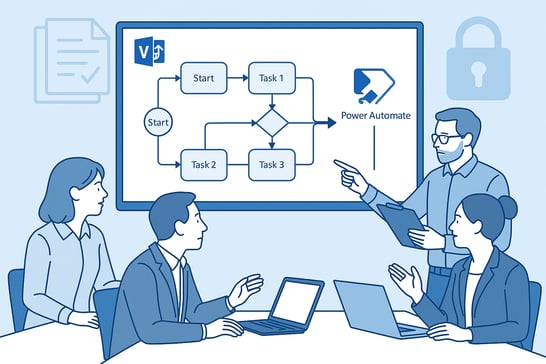
Simulating Outcomes to Validate Business Impact
Once future-state processes are defined, Mavim makes it possible to compare them directly with the current state. This comparison highlights where efficiency is gained, where risks are reduced, and where automation or AI delivers tangible value. Microsoft capabilities are no longer described in abstract terms. They are directly linked to specific process improvements and business outcomes.
This creates a value narrative that stands up in executive discussions. Instead of relying on projected benefits after delivery, sellers can demonstrate expected impact before contracts are signed. Business cases become stronger, executive buy-in becomes easier, and late-stage objections are far less likely.
Visualizing Success for Both Business & IT
Business stakeholders do not want to be walked through system screens or technical architectures. They want to understand how the organization will operate differently once the solution is live. Mavim enables sellers to visualize transformation in business language, showing how work will change across roles, where automation and AI will apply, and how governance and compliance are embedded into daily operations.
This visualization helps the business recognize success before they commit. When leaders can clearly see the future operating model, decisions move faster and with fewer escalations.
How Simulation Changes the Sales Motion
Simulation before implementation reduces risk across the entire lifecycle. By validating processes and outcomes upfront, teams avoid costly rework after go-live. Change requests decrease, implementation timelines shorten, and user adoption improves because the solution already reflects how people work.
For sellers, this leads to higher deal confidence, smoother handovers to delivery teams, and far more predictable outcomes. Sales and delivery stop feeling like separate phases and start operating as one continuous, aligned motion.
Bridging Vision and Commitment
Simulation closes the gap between strategy and execution. It connects high-level transformation goals to concrete process changes. It aligns sales promises with delivery reality. Most importantly, it turns vision into measurable, validated value.
This is where opportunities move forward with confidence. What is being sold has already been tested at the process level, long before the first configuration decision is made.
Positioning Simulation in Customer Conversations
Simulation is especially powerful when customers hesitate due to complexity, when multiple stakeholders need alignment, or when value must be proven before budget approval. It also provides a clear point of differentiation from competitors who rely on feature comparisons and generic demos.
A simple positioning line often resonates strongly: before implementing anything, simulate how the business will change so the organization can commit with confidence. If you want to explore how this approach can accelerate your next Dynamics opportunity, Mavim makes it practical to apply from the very first conversation.
The Practical Takeaway
Simulation before implementation is not an extra step. It is a faster and safer way to close. With Mavim, Microsoft do not just sell Dynamics 365 or AI capabilities.
They sell clarity, certainty, and outcomes that customers can see and trust before delivery even begins.
Read more in our ebook on value of the BPC in Mavim for End Customers and Users→